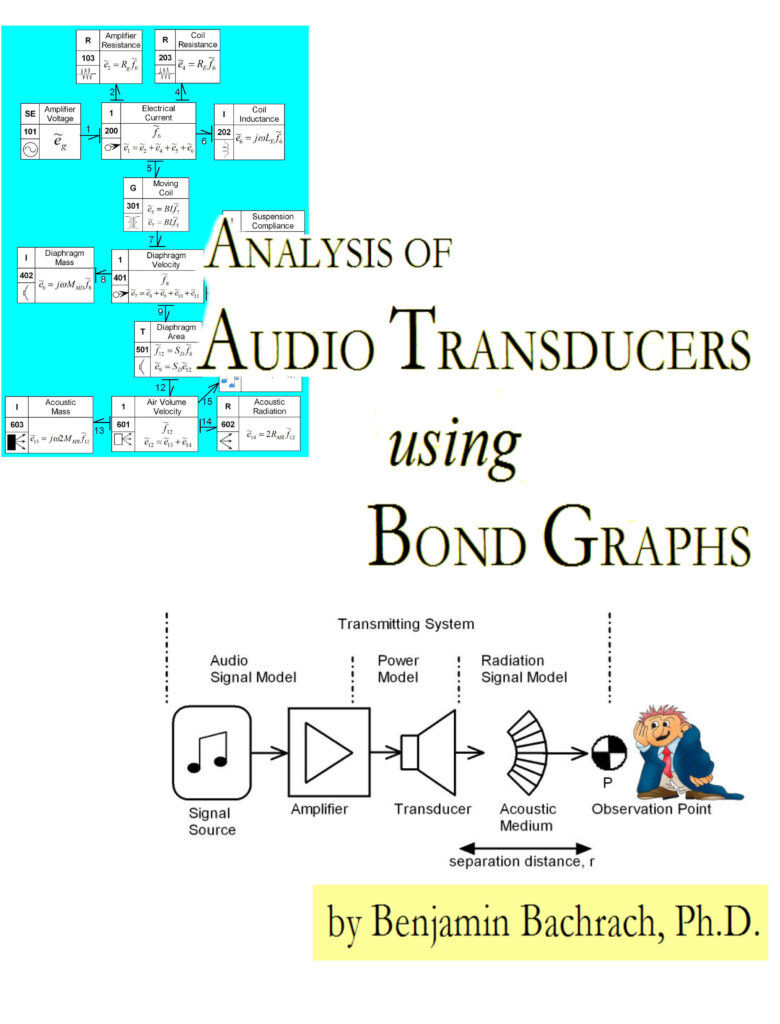
This website introduces a method for modeling audio speakers and microphones. Audio devices included in a Pennsylvania State University course, “Electroacoustic Transducers” previously taught by Prof. William Thompson, Jr. are modeled to illustrate and explain the method.
Dr. Thompson used electrical circuit analogues to model acoustic and mechanical elements along with electrical components. This site uses bond graphs, a multi-domain modeling method invented by Henry Paynter.
Bond graphs present a great deal of information in a concise way. They help the person creating the model, and provide a structured method for generating dynamic equations. However, reading another person’s bond graph is often difficult, even for a trained analyst. To help readers more easily understand the models, this paper uses annotated bond graphs, a set of conventions first proposed by Benjamin Bachrach.
It is expected that readers have some background in acoustics, but the basics needed to understand transducer radiation and to follow the analysis methods for transducers is provided.
The method described here can be applied to other types of acoustic transducers such as hydrophones, and piezo-electric exciters.
Most of the content of this site was approved as a Pennsylvania State University Masters Degree Project in 2006.
The author thanks his project advisor, Dr. Richard Tutwiler, the late Professor William Thompson, Jr., and Dr. Robert Bachrach for their careful reading of the first manuscript, and suggestions.
The motivation for undertaking this project came from the course on electro-acoustic transducers presented by Professor William Thompson, Jr. at Penn State, and to the introduction to bond graphs the author received from Professor Ronald Rosenberg of Michigan State University.
Thanks is also due to Daniel Adelson for his assistance in finding reference materials at the Wayne State University Science and Engineering Library.
Analysis of Audio Transducers