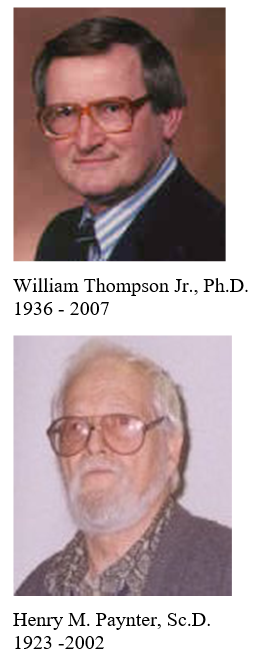
A modeling method for predicting the ideal behavior of electro-acoustic transducers is presented. Detailed system models for loudspeakers and microphones are examined. These devices were covered in “Electroacoustic Transducers”[1], a Pennsylvania State University course formerly taught by Prof. William Thompson, Jr. using an approach developed by Beranek[9].
Numbers in brackets refer to references listed here
Thompson and Beranek used electrical circuit analogues to model acoustical and mechanical elements along with electrical components. This paper avoids the difficulties many encounter when faced with learning to manipulate impedance and mobility electrical circuits by using a bond graph approach. Bond graphs are a multi-domain modeling method invented by Henry Paynter [2].
Details about bond graphs can be found in textbooks devoted to the subject [3, 4]. Conventional bond graphs present a great deal of information in a concise way. They help the modeler structure the equations in a way appropriate for solution in both the time domain and the frequency domain. The method allows for computer formulation and solution of the system equations using general purpose bond graph programs such as sim-20 [5]. To help readers understand the models and follow the development, this paper uses Annotated Bond Graphs [6].
This paper provides a limited development of acoustic radiation. Detailed treatment of acoustics theory is available in text books such as those by Kinsler and Frey[7], Pierce[8], and Beranek[9], .
Additional information on bond graph modeling of acoustic systems can be found in papers in the Journal of the Acoustical Society of America co-authored by Busch-Vishniac[10]. Reference 10 provides tutorial information on bond graphs, and introduction of bond graph models of transducers, and a bond graph modeling approach for statistical energy analysis. Hanish extensively used bond graphs for acoustic transducers starting in the early 1970’s [11, 12, 13]. His 1999 paper [14] is a summary of the types of models he developed. Reference [15] provides a development and discussion of a bond graph element for modeling a thermally sensitive piezo-electric transducer. The bond graph models displayed in this paper were constructed by following the physics and assumptions used by Thompson[1].
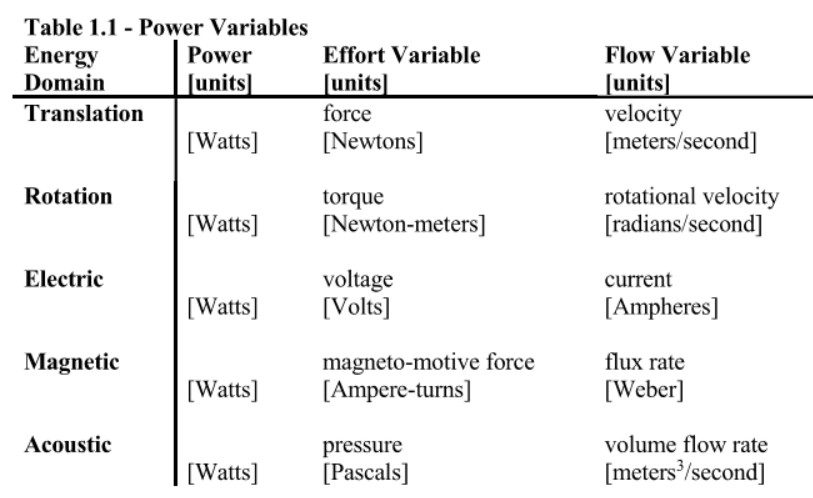
This paper focuses on predicting ideal dynamic behavior of electro-acoustic devices by modeling power flow. Traditionally each category of power was modeled in its own domain. This paper uses bond graphs to provide a unified treatment of power as the product of two factors, effort and flow. Table 1.1 shows the variables used for these two factors in several domains.
The developed equations are then solved using order analysis to characterize a device’s frequency response. The use of the bond graph models presented in this paper will help engineers understand how acoustic transducer design parameters affect frequency response functions.